The website of author Jefferson Flanders

Category: Commentary (Page 1 of 3)

Artificial fiction?

Who can dispute that fiction is a form of artifice? The novelist or short story author creates an artificial world, one that seeks to imitate reality. One of the definitions of “artificial” is that it’s a man-made copy of something natural. With the rise of Artificial Intelligence (AI), that definition will need to recognize copies–imitations– made by machine. (More on that, and the implications for fiction-writing, in a moment).

I suspect literary imitation has been around as long as storytelling. Oscar Wilde argued that imitation was mediocrity’s concession to greatness, but that’s too harsh. Is any work of art completely original?

It had been several years since I had read H.E. Bates’ 1944 novel Fair Stood the Wind For France. Bates tells the story of a Wellington bomber pilot in World War II who, once downed over France, must overcome significant challenges in evading German pursuit. The pilot, John Franklin, falls in love with a young Frenchwoman and she helps him escape. What struck me in re-reading the novel was its obvious creative debt to Ernest Hemingway’s For Whom the Bell Tolls, which was published in 1940.

The similarities are obvious. Bates employs the same flat prose style of Hemingway with its echoes of the King James Version of the Bible. There’s the plot driven by the dangers of operating behind enemy lines. And there’s the romance between the male protagonist and a clever country girl. Imitation is said to be the sincerest form of flattery, and Bates was (consciously or unconsciously) paying homage to Papa Hemingway. Yet, contra Wilde, the novel is not mediocre.

Judged on its own merits, Fair Stood the Wind For France is an entertaining, if somewhat circumscribed, novel that sacrifices emotional depth for narrative intensity. To his credit, Bates stops short of “full Hemingway,” and so we’re spared the awkward repetitious meanderings of For Whom the Bell Tolls. (For what it’s worth, I’d argue that A Farewell to Arms is Hemingway’s greatest work). Yet to give credit where credit is due, despite some derivative elements Fair Stood the Wind For France can lay claim to its own authenticity: Bates had been commissioned into the Royal Air Force to write stories dramatizing aerial warfare, and he could draw on the experiences of the pilots and air crews flying into combat.

Questions about imitation and authenticity will abound in the Age of AI. Already Amazon is working to choke off so-called AI “scam books,” which include AI-generated biographies, summaries of popular books, and copycat books. Jane Friedman, a writer and publishing industry analyst, interviewed by NPR last year argued the current crop of AI-books had a inhumane, generic quality: “It just feels like a human didn’t write these. Humans would — funnily enough — do a better job being bad.”

But it’s clear it’s only a matter of time before generative AI is employed to create works that pass the literary equivalent of the Turing test. Nonfiction shouldn’t pose much difficulty for large language model (LLM) AI, assuming an ample underlying database with vetted content and some level of human review to spot and eliminate hallucinations and other ghosts in the machine.

Fiction presents more challenges. Screenplays–which are largely made up of dialog and typically have simple plots–are a logical initial AI target. There are clear patterns and archetypes for AI to mimic– the three act structure, and the twelve steps of the Hero’s Journey. Netflix and Amazon have collected vast amounts of viewer data which they feed to AI to help fashion more compelling scenes.

Novels are more complex, but their narrative structure can be copied. Some genres will lend themselves to AI imitation. And certainly AI can copy the distinctive style of a Hemingway (or Jane Austen or Cormac McCarthy) and generate prose that mimics the original.

Could AI produce a novel that mimics Fair Stood the Wind For France in the way Bates borrowed from Hemingway? Could it generate a tense World War II story set behind enemy lines with a young hero helped/saved by a courageous and appealing farm girl? For now, I think the AI engine would still need someone (a human) providing extensive prompts to create a seamlessly executed novel. (Note bene: I won’t be the one experimenting. I’ve kept my distance from AI on both practical and principled grounds). Tomorrow? AI writing fiction autonomously? Who doubts that it is technically possible? Considering recent claims that AI may be learning to shake off human control (the SkyNet threat), we may not have much of a say in the matter.

© 2025 Jefferson Flanders

Where the stories come from

So where do the stories come from?

Are they drawn from a Jungian collective unconscious? Stories from our primal past, of hunting and being hunted, of rivalries within the tribe and without. Stories with a structure, the Hero’s Journey, the monomyth.

The emotional foundation underlying these stories aren’t uniquely human. Take anger or jealousy. If you watch video of an experiment with capuchin monkeys (conducted by the late primatologist Dutch Frans de Waal) you’ll discover that our primate relative are capable of rage and envy if they think they’re being treated unfairly.

So there’s a deep evolutionary reservoir for anyone creating to draw upon. And a psychological one. Although Dr. Freud has fallen out of favor, his insights into human behavior are, in essence, a form of storytelling. (Freud admired William Shakespeare and the Bard had a significant influence on the development of psychoanalytic theory.)

Then, there’s the body of literature waiting to be strip-mined for plots and characters. Writers are literary magpies, always ready to create derivatives. Sometimes their borrowing is overt, sometimes not so (thus, plagiarism scandals).

At a more subconscious level, there’s the impact on an author of every word they’ve ever read. The choice of words, the cadence, the propensity for plain prose or something more Rococo, are influenced by what the mind takes in.

Finally, there’s the creator’s imagination. The story emerges, imagined, through a smelting process that refines these remembered elements into something recognizable, something that appeals to us, that makes us want to learn more, to read on, to turn the page.

© 2025 Jefferson Flanders

The journalists of Budapest, 1956

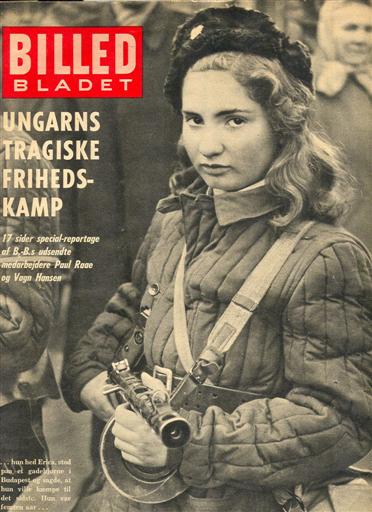
Sixty years ago the striking photograph of a teenage girl dressed in a cotton-wool jacket and clutching a Soviet PPSh-41 submachine gun became an iconic image of the Hungarian Revolution.

A Danish photojournalist, Vagn Hansen, had snapped the photo as Hungarian insurgents battled Soviet troops in the streets of Budapest in late October and early November of 1956. First published in the Danish magazine Billed Bladet, the photograph quickly was reproduced in newspapers and other publications around the world.

static1-squarespace
Hansen was one of a talented and brave group of foreign correspondents and journalists who covered the Hungarian uprising. Historian János Molnár has estimated that some 150 newsmen and women, most from the West, found their way to Budapest during the uprising.

The mass media coverage of the Hungarian Revolution offered an object lesson in the value of a free press. As the faltering Communist regime lost control of the borders, foreign correspondents were able to enter the country. Once there, the absence of government “minders” and censors allowed journalists to report what they saw, “without fear or favor of friend or foe.” The result: a balanced, independent, and accurate account of what was happening on the ground in Hungary.

This on-the-spot coverage had an impact. The stories, and pictures, of Hungarian insurgents resisting Soviet power helped illuminate the gap between Communist propaganda and the reality of life in the satellite nations of Eastern Europe.  The brutal crackdown on the revolutionaries damaged the appeal of Marxist ideology in Western Europe and elsewhere, hurting the image of the Communist parties in France and Italy.

The reportage from Budapest also influenced U.S. foreign policy. Journalists found that many Hungarians believed, falsely, that NATO would intervene to defend the revolution based largely on Radio Free Europe broadcasts that had encouraged resistance to the regime. In response,  President Dwight Eisenhower publicly claimed that the U.S. had never “urged or argued for any kind of armed revolt which could bring about disaster to our friends,” and privately curtailed rhetoric about rolling back Communism in the satellite nations.

Witnessing the revolution

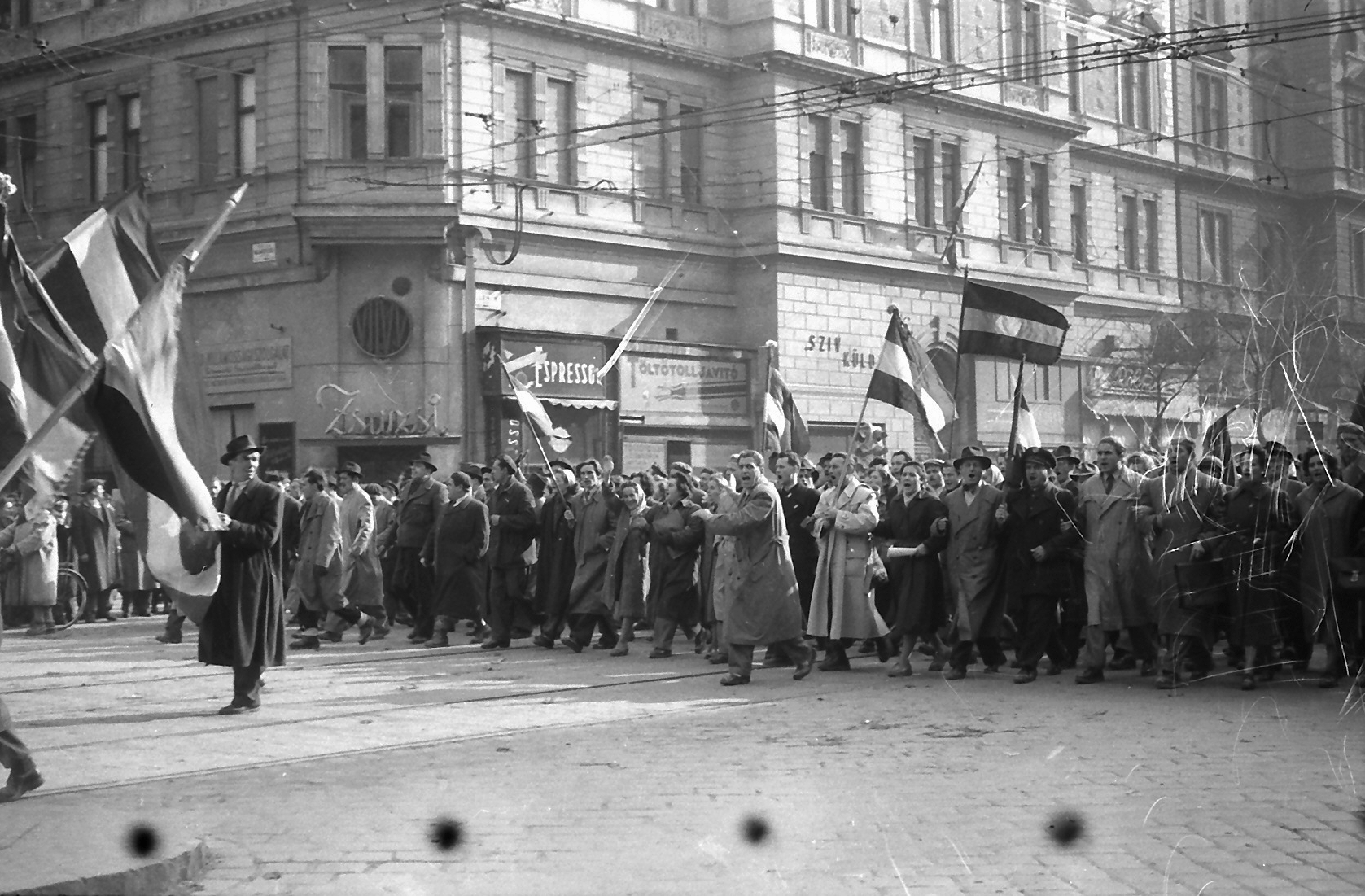
While the uprising caught most Western news organizations (and intelligence agencies) by surprise, there were a few experienced newsmen in Budapest when students and workers began demonstrating against the repressive regime and the presence of Russian troops on October 23. Endre Marton of the Associated Press, John MacCormac of The New York Times (assisted by Aurél Varrannai), Sefton Delmer of the London Daily Expressand Leslie Bane of the North American News Alliance reported on the extraordinary events of the first hours of the revolt, the mass rally in Parliament Square,  the battle over the Radio Budapest station, and the toppling of the giant statue of Stalin in Heroes Square.

fortepan_23686
Delmer filed an emotional first-person dispatch by telephone: “I have been the witness today of one of the great events of history. I have seen the people of Budapest catch the fire lit in Poznan and Warsaw and come out into the streets in open rebellion against their Soviet overlords. I have marched with them and almost wept for joy with them as the Soviet emblems in the Hungarian flags were torn out by the angry and exalted crowds. And the great point about the rebellion is that it looks like being successful.”

Soon more journalists arrived in the city, cramming into the Duna Hotel on the east bank of the Danube. Newspaper and wire service reporters and broadcasters came from the United States, England, France, Italy, Germany, Denmark, and the Netherlands. Polish and Yugoslav correspondents, who proved sympathetic to the insurgents, also filed reports.

Despite the danger, small groups of journalists ventured out to observe the street battles between the revolutionaries (many of them teenagers), and Soviet troops in places like the Corvin Passage and Széna Square. Photojournalists maneuvered to get close to the action. Michael Rougier of Life magazine shot a series of dramatic photos of the carnage that included images of  burned-out tanks, bodies lying in the cobblestone streets, and makeshift graves of the fallen. Erich Lessing, an experienced Austrian photojournalist, documented the intensity of the fighting and the resulting devastation of the graceful boulevards and buildings of the city.

The journalists in Budapest didn’t shy away from reporting the often grisly scenes of the revolution. Marton and MacCormac were eyewitnesses to the massacre of civilians in front of the Parliament Building on October 24, when Russian tanks and secret police snipers killed hundreds. At the same time, there was no hesitation in reporting atrocities by the insurgents.  Life magazine’s John Sadovy took disturbing photos of the summary execution of Hungarian secret police in Republic Square on October 30. One of the photographers on the scene, Jean-Pierre Pedrazzini of Paris Match, was hit by machine gun fire and later died from his wounds.

As the Red Army encircled Budapest in the first days of November, many foreign correspondents decided to leave while they still could.  Some left with the convoys to Vienna organized by British and American diplomats. Nearly all of those who stayed after the Soviet onslaught of November 4, took shelter in Western embassies.

Two of the last Western journalists in Budapest were MacCormac and Russell Jones of United Press International. Jones, who won the Pulitzer Prize for his reporting on the revolution, was expelled on December 5, and the János Kádár regime sent MacCormac packing  on January 10, 1957.

After leaving Hungary, Jones challenged Soviet claims that the uprising was fomented on behalf of capitalists or large Hungarian landowners. “I saw with my own eyes who was fighting and heard with my ears why they fought,” he wrote, adding, “Wherever came the spark, it found its tinder among the common people. The areas of destruction, the buildings most desperately defended, and the dead themselves are the most eloquent proof of this.”

Despite the thousands of news stories filed about the Hungarian Revolution, the name of the girl with the submachine gun in Vagn Hansen’s iconic photo remained unknown until the 21st century. It was only then that researchers identified her as Erika Szeles, a young soldier and nurse. She was already dead by the time her photo appeared on the front cover of Billed Bladet,  killed on November 8 trying to help a wounded friend during a firefight with Russian soldiers. Szeles was fifteen years old.


Jefferson Flanders is an independent journalist and author. His novel The Hill of Three Borders is set during the Hungarian Revolution of 1956.

This essay first appeared on RealClearHistory.

Copyright © 2016 by Jefferson Flanders

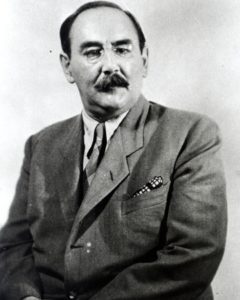
Imre Nagy, the unlikely and reluctant hero of the Hungarian Revolution

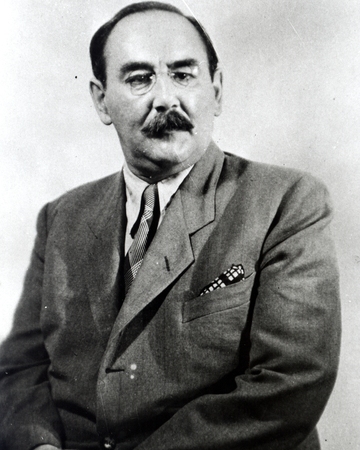
Sixty years ago this month, an avuncular Communist apparatchik named Imre Nagy became the unlikely hero of the Hungarian Revolution.

Nagy was thrust onto the world stage during the last weeks of October 1956 as Hungarian students and workers rose in revolt against an unpopular and repressive Communist regime and battled Soviet troops in the streets of Budapest.
imrenagy

In the space of a few fateful days, Nagy assumed leadership of the revolutionary government and advanced previously unthinkable political changes, calling for an independent, neutral Hungary, a multiparty democracy, and free elections. He moved to disband the hated secret police and to free political prisoners.

Nagy publicly rejected the Soviet propaganda line that the uprising represented a counterrevolution led by fascists and reactionaries, arguing instead that “this movement aims at guaranteeing our national freedom, independence, and sovereignty, of advancing our society, our economic and political system on the way of democracy.” As the Red Army began to encircle the Hungarian capital in the first days of November, Nagy must have known that he was signing his own death warrant by forming a coalition government—challenging Marxist-Leninist orthodoxy which insisted that the Communist Party alone should rule—and appealing to the United Nations General Assembly for help in defending Hungary’s neutrality.

Nagy was an implausible hero. A portly, 60-year-old with a distinctive walrus mustache who liked to take his grandchildren for ice cream at Café Gerbeaud and rooted for Honved, the Hungarian Army’s soccer club, Nagy didn’t fit the romantic Hollywood image of a revolutionary leader. He had spent most of his adult life as a Communist functionary. The son of a peasant, he became a Communist in his early twenties, living in Moscow on-and-off from 1930 to 1944. During the Stalinist purges, he was an informant (Agent Volodya) for the NKVD (later the KGB).

In the thaw after Stalin’s death, the Soviet leadership elevated Nagy, regarded as a moderate, to premier of Hungary in 1953. Nagy introduced a series of agricultural and economic reforms, dubbed the New Course, and sought to liberalize political discourse. His vision was of “Communism which does not forget about man.” Hungarian hardliners, led by the widely detested and feared Party boss Mátyás Rákosi (known as the “Bald Murderer”), struck back in 1955, removing Nagy and drumming him out of the Hungarian Workers’ Party. He was not admitted back into the Party until a week before the uprising.

When students and workers began demonstrating on October 23, partly in response to political unrest in Poland, they called for Nagy to lead the country, seeing him as an honest man of the people. As Nagy reluctantly re-entered the political arena, the regime’s hardliners summoned Soviet troops and tanks to suppress the insurgents. Freedom fighters took to the streets of Budapest, and the revolution rapidly spread to the rest of the country. Nikita Khrushchev and the Soviet Presidium, hoping to avoid a protracted and violent conflict, agreed to Nagy assuming the premiership, believing that he could be trusted to tamp down the unrest. After several days of street battles, the Russians accepted a ceasefire and pulled back their troops. On October 30, Moscow announced it would respect Hungarian sovereignty and negotiate the presence of Russian armed forces in the country. Further signaling an apparent willingness to compromise, the Kremlin broached the idea of a commonwealth of socialist states. For a brief moment, it appeared as if Hungary might throw off the Soviet yoke, perhaps adopting a system similar to Tito’s national communism in Yugoslavia.

Pressured by the revolutionaries, Nagy reluctantly went further, announcing a series of dramatic reforms that would have transformed Hungary by ending one-party rule and adopting “bourgeois freedoms.” In his radio address on November 1, when he declared the country’s neutrality, Nagy made a bold claim: “…The revolutionary struggle fought by the Hungarian heroes of the past and present has at last carried the cause of freedom and independence to victory.” He was wrong about winning a victory, of course, as Hungary’s brief flirtation with democratic governance was to end in a few days.

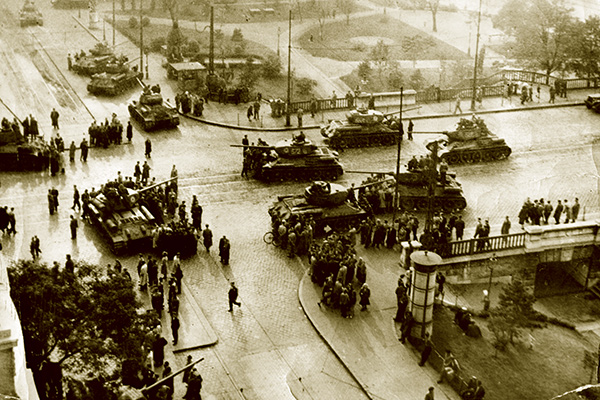
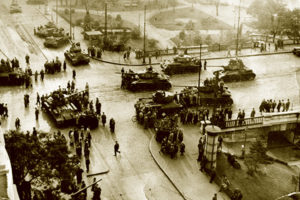
Moscow, however, could not accept this outright rejection of Communist rule and Hungary’s departure from the Warsaw Pact. Even the Politburo’s Anastas Mikoyan, who privately counseled against any military response, admitted: “We simply cannot allow Hungary to be removed from our camp.” The Kremlin feared contagion. Hungary’s uprising had stirred unrest in other satellite nations—protests in Poland, Czechoslovakia, and Romania—and Mao Zedong and the Chinese pressured Khrushchev for a crackdown. Soviet heavy T-54 tanks rolled into Budapest on November 4, and the Red Army crushed the uprising, killing thousands. Moscow quickly installed a puppet government led by Hungary’s Quisling, János Kádár. Nagy was tricked out of temporary sanctuary in the Yugoslavian Embassy, arrested, and held in Romania until his trial in June 1958.
russiantanks_budapest

Today, Nagy’s home on Orsó Street in the Buda hills is open to the public as a shrine of sorts to this martyr of the revolution. Like the man, it’s modest and unassuming (by American standards). It’s here, in this comfortable Bauhaus-style villa, that you sense Nagy’s quiet courage and resolve and realize the sacrifice he made. Nagy had suffered a heart attack in 1955—he could have honorably resisted the calls for his return to political power and remained safely out of harm’s way. Or he could have denounced the uprising as a counterrevolution? Or he could have resigned from the government as the revolution pushed well beyond cosmetic reforms into forbidden political territory. But he didn’t.

What was the tipping point for him? Was it seeing the demonstrators from all walks of life outside the Parliament Building, calling for the Russians to go home? Or observing the courage of the teenagers of Budapest, attacking Soviet tanks with home-made Molotov cocktails? Or perhaps even guilt over his complicity in the Great Terror of the early 1950s, when the Communist regime purged and prosecuted hundreds of thousands of innocent Hungarians?

Nagy claimed to have remained a Communist to the bitter end, but he must have been conflicted about what that meant. Defending his actions during the uprising, Nagy argued that he had been trying to preserve a socialist future for Hungary by rejecting the “forms of ideological, political and governmental dependence that were developed in Stalin’s regime.” Yet Nagy must have recognized what historian Johanna Granville has called the “fundamental contradictions of de-Stalinization.” Reformers struggled with the realization that Stalin was simply the personification of a deeply flawed ideology—and they learned that Marxist-Leninist dogma doomed attempts to establish “socialism with a human face” (Alexander Dubček’s later formulation during the Prague Spring).

Perhaps Nagy continued to believe that a purified Marxism could be the engine for a Socialist Paradise. His willingness to accept a multiparty state suggested otherwise. His hardline comrades saw things more clearly. State socialism demands a monopoly of power, and the unrelenting control of all aspects of life, with state-sanctioned terror to maintain order. It cannot allow the existence of free elections or democratic institutions.

What a man of the apparat like Kádár understood was that the Party could not risk an uncensored press or seek the consent of the people. The Hungarian Communists could not win free elections—they polled 17 percent of the votes in 1945 and 22 percent in 1947 during Hungary’s brief post-war period of political openness. They won power through Rákosi’s infamous “salami tactics,” eliminating the opposition through threats and intimidation. Unlike Nagy,  Kádár and the Party cadre would would never willingly accept relegation to a minor role in a parliamentary democracy.

At his secret trial for treason, Nagy was clear-eyed about the fate of apostates. He told the court: “If my life is needed to prove that not all Communists are enemies of the people, I gladly make that sacrifice. I know there will one day be another Nagy trial, which will rehabilitate me. I also know I will have a reburial. I only fear that the funeral oration will be delivered by those who betrayed me.”

After his execution by hanging, Nagy was buried in an unmarked grave. It was not until 1989, with the Soviet empire on the verge of collapse, that—as Nagy had predicted—he was reburied with full honors. Several hundred thousand Hungarians attended the reburial ceremony in Heroes Square in Budapest, and opposition leaders seized the opportunity to excoriate the ruling Communist regime. Nagy’s betrayers only had a few more months in power before they were swept away by the tidal wave of democratic revolution.

In the end, Imre Nagy’s legacy as the “lonely hero” of 1956 remains secure. His vision of a non-Stalinist socialist society may have been tragically flawed, but he had the courage to risk all in pursuit of that dream. “He did not make the revolution. But he made it possible,” former British diplomat Peter Unwin has written. “Nagy and the revolution went down to defeat, but they gave Hungary back its self-respect.”


Jefferson Flanders is an independent journalist and author. His novel The Hill of Three Borders is set during the Hungarian Revolution of 1956.

This essay first appeared on History News Network.

Copyright © 2016 by Jefferson Flanders

A voice of one’s own

The late poet and novelist Jim Harrison (best known for Legends of the Fall) told the New York Times earlier this year that: “I can’t read novels while I’m writing them because of the imitative nature of the brain. So I get along with a few European mysteries and lots of poetry.”

Harrison’s concerns were surprising. It’s true that many songwriters avoid listening to music when composing for fear of unconscious imitation, but you wouldn’t think that a seasoned novelist would worry about (mis)appropriating what he or she had read.

Writers work differently, of course, and I can only speak for myself. When I write, the words that I hear in my head and translate to the page are in my own voice. No doubt it’s a voice that has been shaped by my childhood exposure to plain style writing (the King James Bible, the Book of Common Prayer, Jane Austen, Rudyard Kipling, A.A. Milne, Sir Arthur Conan Doyle, Mark Twain, Ernest Hemingway, etc.). My writing naturally reflects those influences.

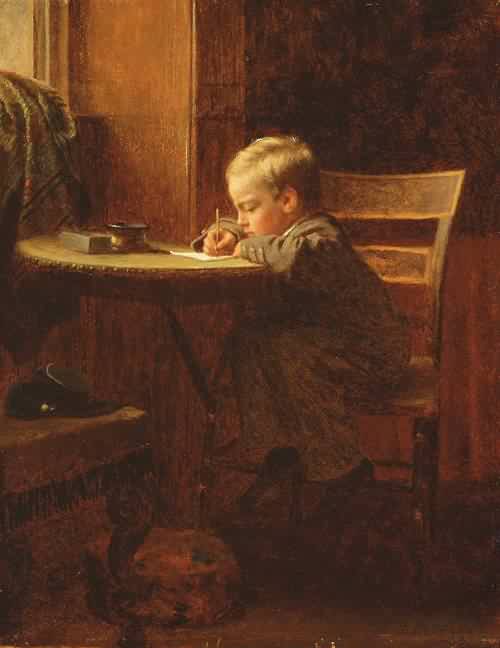
Eastman-Johnson-xx-Writing-to-Father-1863

Unlike Harrison, I don’t worry about reading someone else’s fiction when I’m working on a novel. I don’t fear unconsciously imitating another author’s style or lifting extended patches of prose—anything borrowed wouldn’t make it through my revision process. I revise line-by-line by reading out loud and changing what doesn’t sound right to me—that is, what doesn’t match the voice in my head.

I’m even less concerned about imitation when reading an author with a distinctive and unique style. For example, I just reread Mark Helprin’s wonderful novel Refiner’s Fire; when I look at the passages I’ve underlined in the text, I’m not worried about imitation. I know if I tried to match his voice it would ring completely false. Consider the following bit of dialogue crafted by Helprin:

“I have been learning English. Since the time of Erasmus we Dutch have envied the English. What an ecstatic language, a language to fill the boots of the greatest dream, a language of milk, a language of jewels. In itself it is worth more than nations. It strives and it loves, in words and phrases. Needless to say, like the waterbug, or the needle, we too love it and respect it as our king.”

Wonderful stuff—I admire Helprin’s word play, his poetic ear, and his sense of rhythm. But I can’t imagine writing (or imitating) something like this, even if I wanted to. It’s not the way I translate what I see and experience in the world into words. And when I read it out loud, it’s an intriguing and lyric voice—but clearly not mine.


Copyright © 2016 by Jefferson Flanders

« Older posts

© 2026 Jefferson Flanders

Theme by Anders NorenUp ↑